Local drain guide
What actually blocks drains in Castle Hill
Fifty years of trees over sixty-year-old drainage
This land was orchard before it was houses. When the estates were laid out from the 1960s the drainage went in with them, and so did the planting, on blocks generous enough to take substantial trees.
Both have now had half a century. Roots go where the moisture is, which means the nearest joint, and once they are inside they regrow after every clear. That is why a drain here blocks at roughly the same interval year after year rather than randomly.
Thirty metres of pipe is a lot of pipe
A 900 square metre block puts real distance between the house and the street. Every metre of that is pipe, and every join in it is a place a root can enter or a deposit can catch.
It also means the fault is often invisible from the house. No wet patch, no smell, nothing in the garden to point at, because it is twenty five metres away under lawn. On a small block you can sometimes reason your way to the answer. Here you cannot, and that is what the camera is for.
Locating is what keeps the repair small
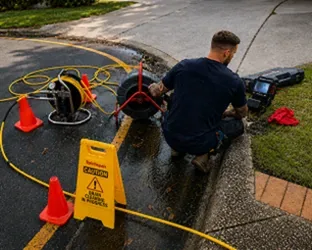
Once we know where the fault sits, we mark it on the surface. If anything has to be opened up it is one spot, in a known place, rather than an exploratory trench following a pipe down a yard.
On a block with mature planting, a pool, a driveway and established garden beds, that distinction is worth a great deal more than the cost of the inspection.
The one-off versus the pattern
Worth being honest about: a first blockage rarely needs a camera. Something went down, we clear it, you get on with your day.
A second blockage in the same line inside a year is a different conversation, because the interval is information. That is the point at which paying to see the pipe stops being an upsell and starts being the cheaper path, especially given what lining a long run costs if you get the diagnosis wrong.
What to check before you call
Is it one fixture or several? A single slow basin is usually local to that fixture. Several at once, or a toilet and a shower together, means the problem is further down the shared line.
Is the outside gully overflowing? That is the relief point, and if it is running while fixtures inside back up, the blockage is downstream of the house and out in the yard somewhere.
Which fixtures, and in what order
A single slow basin is local to that fixture and its trap. Several fixtures misbehaving, or the lowest one in the house backing up, is the main line out telling you so.
The lowest point is where a restricted main line shows first, and on most of these houses that means a laundry tub, a shower or a floor waste rather than the toilet everybody watches.
Run the bathroom, then the kitchen, and see whether the trouble follows you around the house. Two minutes of that is worth more than any description of the smell.
Wipes and kitchen fat, the ordinary causes
Wipes remain the largest single cause of what we cut out of house drains, whatever the packet claims about flushability. They stay intact, they snag, and they hold everything that arrives behind them.
Kitchen fat is the slow version. It cools onto the pipe wall, narrows the bore a fraction at a time, then starts collecting whatever comes past.
On a long run these matter more than they do on a short one, simply because there is more pipe for material to stall in and more distance for it to slow down over.
Rain changes what the problem probably is
A sewer blockage does not care about the weather. It was there yesterday and it will be there tomorrow. Trouble that only arrives in a downpour and eases when it stops is the stormwater side.
On blocks with orchard-era planting and a mature canopy, wet-weather trouble is very often gutters, downpipes or a stormwater pit packed with leaf litter rather than anything wrong with the sewer.
Saying which one you have saves paying for the wrong machine, and the two travel separately.
Where the access point is on a block this size
Usually a capped riser near the boundary on the side the sewer runs down, and frequently a long way from the house. On a 900 square metre block that can be thirty metres from your back door.
It is worth finding and marking, because every future clearance is faster and cheaper from outside than through a fixture indoors.
Paving, decking and garden beds added over the decades bury them routinely. Once we have found yours, a marker means nobody hunts for it again.