Local leak guide
What actually goes wrong with pipes in Castle Hill
The leak that never reaches the house
A service line failure on a long run does not produce a dramatic symptom. It produces a slightly greener strip of lawn, ground that stays soft after everything else has dried, and a bill that has crept up.
Because none of that is alarming, these run for months. The ten minute test that settles it costs nothing: turn every tap and appliance off, then watch the meter. A dial still moving means water is escaping somewhere between the meter and the house.
Fifty year old copper fails quietly
The original copper in these estates is now forty five to fifty five years old. At that age it develops pinholes rather than splitting, and a pinhole under pressure inside a wall or under a slab can seep for months before it surfaces.
Falling pressure over several years, a recurring stain, or a bill drifting upward are the warning signs worth acting on. Replacing a failing section on a schedule is a known price. Replacing it after it lets go is the same job plus whatever the water did.
Why we listen along the pipe instead of digging at the wet spot
Water escaping underground travels before it surfaces, following whatever path the ground offers. On a long, shallow service run the visible wet patch can be well away from the actual failure.
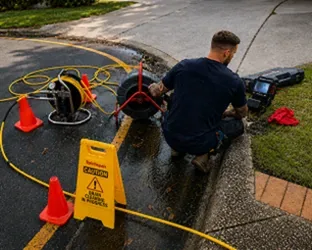
Acoustic listening follows the sound of water escaping under pressure along the line itself. We then mark the position on the surface, which is what turns a repair into one opening rather than a trench following a pipe across a lawn, a garden bed and a driveway.
Pressure, and what it is actually telling you
A gradual drop in pressure over years usually means the bore of something is narrowing, or a service line is partially failing. A sudden drop usually means something has let go.
It is worth measuring rather than guessing, because the fix for low supply pressure and the fix for a degraded service line are completely different jobs at completely different prices, and only one of them is worth doing.
Repair again, or replace the run
The honest conversation on a long run of aged copper is whether patching it a third time is sensible. Each repair is cheap; three of them plus the water lost between is not.
Replacing the service line is a bigger job with a known price, and on an open block with lawn between the meter and the house it is usually more straightforward than people fear. We will put both numbers in front of you rather than quietly repeating the repair.
The meter test, and what it rules out
Close everything, including the machine and the dishwasher, and watch the smallest dial on the meter for a couple of minutes. Movement means water is genuinely leaving the property.
A dial that sits perfectly still points at usage rather than a fault, which on a block this size usually means irrigation, a pool topping itself up, or a cistern passing quietly.
Turn the irrigation controller off entirely before you run the test rather than just to a rest day, or it will run during the measurement and confuse the answer.
Narrowing it down without any equipment
Once the meter has confirmed a loss, close the isolating valve feeding the hot water unit and take a second reading. Two minutes, no tools.
Continued movement means the cold side. No movement means the unit itself or the hot pipework it feeds.
Have a look at where the relief valve discharges before you assume the tank is at fault, because a valve running steadily looks the same on a meter and is far cheaper to fix.
Know where the stop tap is before you need it
What a burst costs is decided in the minutes between the failure and somebody closing the water. The repair afterwards is ordinary work. The minutes before it are flooring and cabinetry.
On a long frontage the meter can be a genuine walk from the house, which matters at two in the morning. Find it on a dry afternoon and check the tap actually turns.
Learn the isolating valves indoors as well, because closing one of those handles a specific failure without taking water off the whole property.
The cheapest insurance in the building
A set of braided hoses costs very little and takes a plumber a short visit to replace. The damage one causes when it lets go runs to insurance-claim numbers.
They have a service life of roughly five years and they do not degrade politely. There is no drip that warns you.
Turning the isolating valves under a vanity off before a week away costs nothing and removes the risk entirely for that period.
Irrigation is the biggest single use on a block this size
A reticulation system on 900 square metres frequently moves more water than the household does, and a failed solenoid or a split poly line does what a leaking cistern does: continuously, invisibly, into the ground.
It also defeats the meter test if the controller runs during it, so turn the controller off entirely rather than to a rest day before you measure anything.
If the dial stops when the irrigation is isolated, that is the answer, and it is a cheaper one than most alternatives on this page.
A bill that has climbed with nothing visibly wet
On a long service line under lawn, escaping water goes into the ground and produces no puddle anybody would notice. The quarterly account is frequently the only symptom.
The order of work is the meter test, then the hot water isolation, then the run between the meter and the house. That last one is the expensive possibility and the one worth ruling out early.
On thirty metres of forty-five-year-old copper it is also the likeliest, which is why we start listening along the line rather than digging at whatever looks damp.
Repair again, or replace the run
The honest conversation on a long run of aged copper is whether patching it a third time is money spent or money postponed. Each repair works. The pipe is still the age it is.
Replacement of a full service line is a real cost and it is not always the right call, particularly where the failures have all been at one end.
What decides it is where the failures have been and what the rest of the run looks like when tested, not a rule about age.